Lecture 16: Export Procedures and Documentation
Econ 2203 | International Trade and Policy in Agriculture
Department of Development Economics
2026-08-08
Opening: The Journey of a Kilo of Tur Dal
A kilo of Kalaburagi tur dal travels from a Karnataka farmer to a diaspora kitchen in Leicester, UK.
What stands between the farmer and the foreign consumer?
- Registrations with four government agencies
- Twelve documents crossing seven desks
- Two financial instruments spanning two continents
- One customs portal used by 1.4 million exporters
Today’s lecture answers: how does this actually work?
India’s agri export snapshot (FY2024):
- Total agri exports: ₹3.61 lakh crore (~$43.7B)
- Agricultural exporters registered: ~85,000
- Ports handling agri cargo: 13 major + 200 minor
- Average documents per shipment: 8–12
Every export begins with a registration and ends with a bank certificate.
Step 1 — Pre-Export Registrations: The Four Pillars
Before any shipment, an agricultural exporter must hold:
1. Import Export Code (IEC) - Issued by DGFT (Director General of Foreign Trade) - 10-digit PAN-based code — mandatory for all exports - One-time registration; lifelong validity - Apply online at dgft.gov.in — fee ₹500
2. RCMC (Registration-cum-Membership Certificate) - Issued by the relevant commodity body: - APEDA — processed food, fresh produce, meat, dairy, cereals - MPEDA — marine products - Spices Board — all spices - Coffee/Tea/Rubber Board — respective commodities
3. GST Registration
GSTIN is mandatory for tax input credit on export supplies. Exports are zero-rated under GST — exporter can claim refund of input taxes.
4. AD Bank Account
Authorised Dealer (AD) Category-I bank account for receiving foreign exchange. FEMA requires all export proceeds to be realised through an AD bank within 9 months of shipment.
Sequence matters: IEC → GST → RCMC → AD Bank account. No RCMC without IEC. No export incentive claim without RCMC.
Export Contracts and Incoterms 2020
An export contract specifies: price, quantity, quality, delivery terms, payment mode, and dispute resolution.
Incoterms 2020 (ICC, Paris) — 11 standardised trade terms that define exactly where risk and cost transfer from seller to buyer.
Key terms for Indian agri exports:
| Term | Risk Transfers At | Used For |
|---|---|---|
| EXW | Seller’s premises | Rare in agri |
| FCA | Named place to carrier | Air/rail shipments |
| FOB | On board vessel | Most Indian agri |
| CIF | Destination port | Buyer-preferred |
| DDP | Buyer’s premises | E-commerce niche |
FOB vs CIF for India:
Under FOB, the Indian exporter’s responsibility ends when goods cross the ship’s rail. Freight and insurance arranged by the buyer.
Under CIF, the exporter arranges (and prices) freight and insurance to the destination port.
~65% of India’s agri exports are on FOB terms. CIF is preferred by Gulf and African buyers who have captive freight arrangements.
Negotiation tip: FOB is simpler for small exporters; CIF offers a higher invoice value and more price control.
Export Documents: Proof of Transaction
- Commercial Invoice — product, quantity, price, HSN/IEC; basis for customs valuation
- Packing List — box-by-box weight and dimensions
- Transport document — B/L (sea) or AWB (air)
- Certificate of Origin (CoO) — used for FTA preferential tariffs
- Key idea: B/L is negotiable (can be endorsed/transferred)
Export Documents: Compliance and Regulatory
- Phytosanitary certificate (PPQS) — plant products are pest-free
- Health/inspection certificate (EIC) — meat/marine/organic/dairy
- Fumigation certificate — pulses/oilseeds; treatment details
- Shipping Bill (ICEGATE) — customs clearance + LEO
- EDPMS (RBI) — links shipment to forex realization
Document flow: a typical agri export
- Contract signed + invoice prepared
- Buyer arranges payment (often via LC)
- Shipment booked → B/L or AWB issued
- Certificates obtained + Shipping Bill filed → LEO
- Documents presented to bank → payment + EDPMS closure
Letter of Credit: Reducing Counterparty Risk
Why LC? In international trade, buyer and seller do not know each other. The LC inserts two banks as guarantors.
Step-by-step LC mechanism:
- Buyer and seller agree on price and LC terms
- Buyer’s bank (Issuing Bank) issues LC in favour of exporter
- Advising Bank (exporter’s bank in India) notifies exporter; may also confirm
- Exporter ships goods; presents documents to advising bank
- Documents checked against LC terms; bank pays exporter
- Documents forwarded to issuing bank; buyer pays and gets documents
- Buyer presents B/L to shipping line → collects cargo
Types of LC:
- Sight LC: Exporter paid immediately on document presentation
- Usance/DA LC: Payment deferred (30, 60, 90 days) — extends credit to buyer
- Revolving LC: Renews automatically for repeat shipments
- Back-to-Back LC: Small exporters use master LC as collateral to open LC for their suppliers
India’s EXIM Bank: Pre-shipment and post-shipment credit; refinances AD banks for agri exporters.
ECGC: Export Credit Guarantee Corporation — insures against buyer default and country risk. Premium: ~0.5–1% of invoice value.
Export Credit: Pre vs Post Shipment Trend
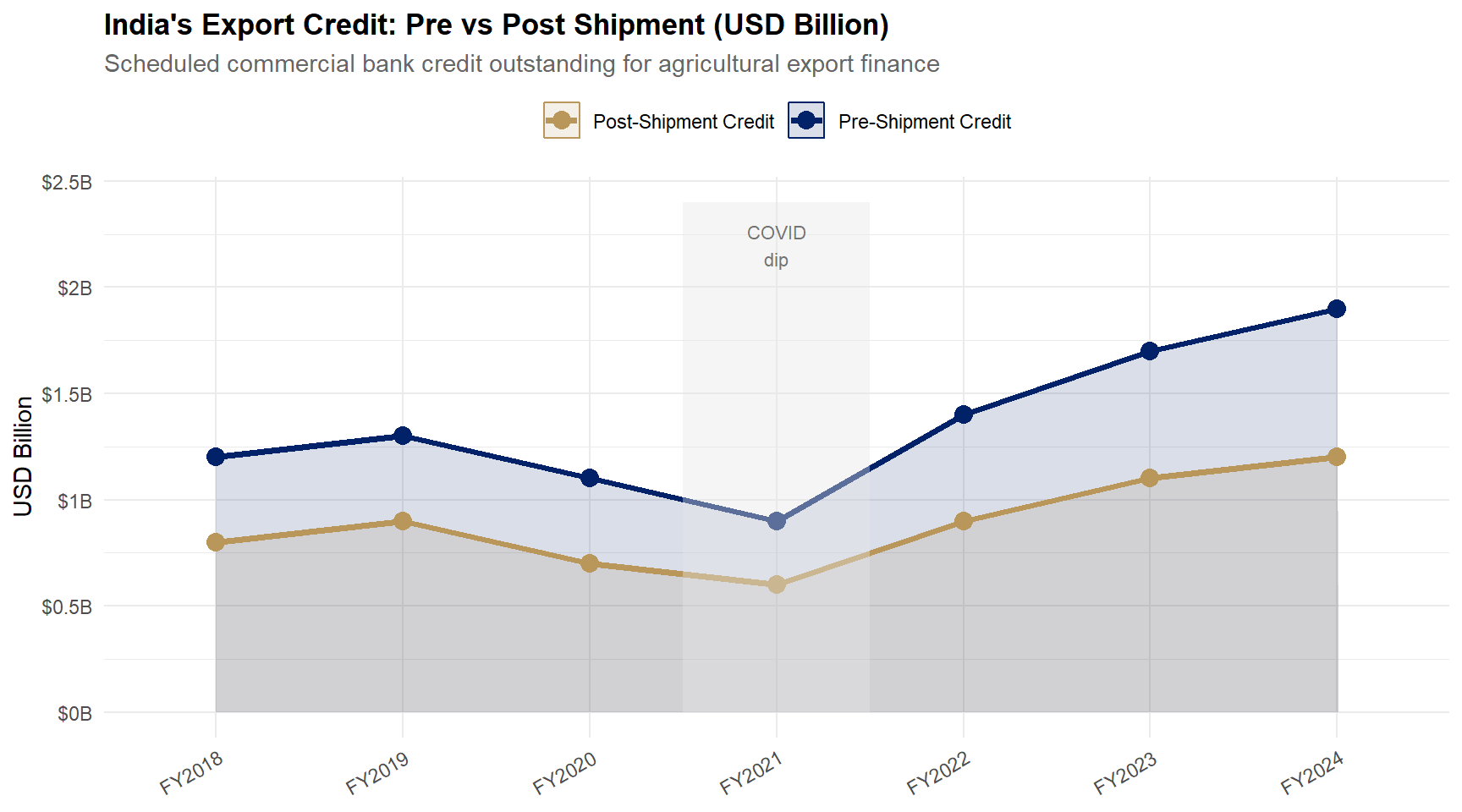
Figure 1: Pre-shipment credit dipped during COVID (FY2021) and recovered alongside export growth; post-shipment credit tracks pre-shipment with a structural lag. Source: RBI, Handbook of Statistics on Indian Economy.
Customs Clearance: ICEGATE and the Shipping Bill
ICEGATE (Indian Customs EDI Gateway) — the single portal for all Indian customs transactions.
Shipping Bill types:
| Type | When Used |
|---|---|
| Drawback SB | Claiming duty drawback on inputs |
| DEEC/Advance Auth SB | Against advance authorisation |
| EP Copy SB | Ordinary exports |
| Free Shipping Bill | Personal effects, gifts |
Process flow: 1. Exporter files Shipping Bill online with all document details 2. Customs Risk Management System (RMS) assesses risk 3. Low-risk: Green Channel → LEO (Let Export Order) in 2–4 hours 4. Medium-risk: Yellow Channel → document examination 5. High-risk: Red Channel → physical examination of cargo
LEO — Let Export Order:
The LEO is the customs officer’s green light for loading. Cargo cannot board without LEO. Once LEO is given:
- Exporter has 24 hours to load at port
- Date of LEO = official date of export for FEMA and incentive purposes
AEO Status (Authorised Economic Operator):
Exporters with strong compliance history can apply for AEO status (Tier I, II, III). Benefits: - Fast-track customs clearance - Reduced physical examination - Priority in port queue - Deferred duty payment
In FY2024, ~12,000 entities hold AEO status in India.
India’s Merchandise Exports by Mode of Transport
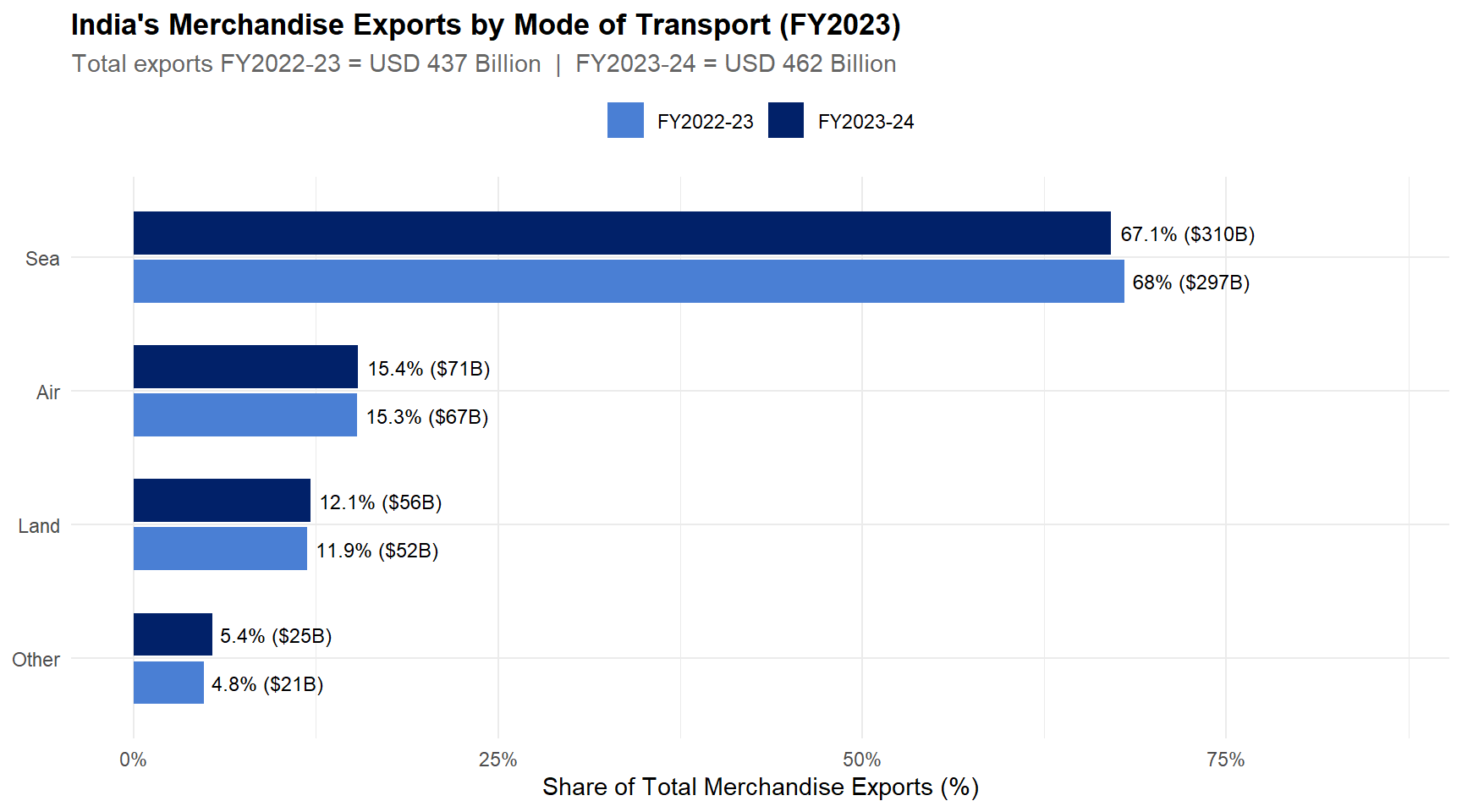
Figure 2: Sea freight dominates at ~68% of India’s merchandise exports; air (~15%) and land (~12%) are secondary modes. Share composition is stable across both years. Source: DGCI&S / Ministry of Commerce and Industry, GoI.
Direct vs Indirect Export Channels
Direct Export: - Exporter deals directly with foreign buyer - Higher margin, full control over branding/pricing - Higher risk (counterparty, forex, compliance) - Requires: IEC, RCMC, AD bank, full documentation - Suited to: large processors, established exporters
Examples: Kohinoor Foods (basmati direct to UAE retail), Venkateshwara Hatcheries (poultry to Middle East)
Indirect Export: - Sell to a Merchant Exporter (ME) who manages the export - No direct forex exposure; simpler for small farmer/processor - Lower price realisation (merchant takes margin) - ME provides GST exemption on purchase from manufacturer at 0.1% CGST+SGST
Export Management Company (EMC): manages exports on commission without taking title to goods.
FPO Route: ::: {.keybox} Farmer Producer Organisations (FPOs) aggregate smallholders (avg. 1.5 ha in Karnataka) to meet minimum export quantity. APEDA’s FPO Connect links 1,200+ FPOs to export markets. Tur dal FPOs in Gulbarga district now export directly to UK Indian grocery wholesalers.
:::
Export Houses: India’s Trade Titans
The Government of India recognises export performance tiers with Star Export House status, conferring priority clearances, bank credit, and EPCG benefits:
| Status | Min. Export (3-yr avg) | Benefits |
|---|---|---|
| Export House | ₹100 crore | Priority treatment |
| Trading House | ₹500 crore | Self-certification of CoO |
| Star Trading House | ₹2,000 crore | Fast-track customs, AEO |
| Premier Trading House | ₹10,000 crore | All of above + policy voice |
Major agri export houses (India):
- ITC Agribusiness: wheat, spices, processed food; exports to 60+ countries; $1B+ annual turnover
- Olam International: cashew, spices, coffee; integrated from farm to retail
- Adani Agri Fresh: apple, potato, processed; cold chain integration
- KRBL Ltd: world’s largest basmati rice brand (India Gate); exports to 90+ countries
- Apex Frozen Foods: shrimp to USA/EU; vertically integrated aquaculture
These firms account for ~35% of India’s total agricultural export value.
Export Incentive Schemes
1. RoDTEP (Remission of Duties and Taxes on Exported Products) - Replaced MEIS in January 2021 (WTO-compliant) - Refunds embedded taxes not otherwise refunded: SGST, mandi tax, electricity duty, stamp duty - Agri rates: 0.5% to 4.3% of FOB value - Issued as transferable scrips on ICEGATE
2. Advance Authorisation (AA) - Duty-free import of inputs used in export production - Standard Input Output Norms (SION) define input ratios - Example: basmati rice exporter imports paddy from Nepal duty-free under AA
3. EPCG (Export Promotion Capital Goods) - Import capital goods (cold storage, processing equipment) at 0–3% duty - In return, commit to export 6× the duty saved over 6 years
4. Transport and Marketing Assistance (TMA) - Freight subsidy for agri exports to notified markets (Africa, EU, USA) - Cover: 50% of sea freight for small exporters; 25% for large - Products: fresh fruits/vegetables, processed food, organic, floriculture
5. MAI Scheme (Market Access Initiative) - APEDA funds participation in international trade fairs (Gulfood Dubai, SIAL Paris, Annapoorna Mumbai) - Buyer-seller meets, market studies, reverse buyer visits - Budget: ₹250 crore/year for all export promotion councils
WTO compliance note: RoDTEP is WTO-consistent (remission of domestic taxes, not export subsidy). AA and EPCG are permissible under WTO SCM Agreement as tax exemptions on inputs. TMA freight subsidy is under scrutiny — USA has raised concerns at WTO DSB.
FSSAI and Food Safety Compliance for Exports
FSSAI (Food Safety and Standards Authority of India)
- Central licensing authority for all food businesses including exporters
- An FSSAI Central Licence is mandatory for manufacturers/processors exporting food products
- Annual turnover > ₹20 crore or multi-state operation → Central Licence
FSSAI’s role in exports:
- Standards alignment: FSSAI standards increasingly aligned with Codex Alimentarius (facilitates market access)
- Organic certification: FSSAI-accredited certification bodies issue Indian Organic Certificate (recognises NPOP)
- Bilateral equivalence: FSSAI has equivalence arrangements with USDA NOP (organic) — US organic certifiers can certify Indian organic products
EIC accreditation for key markets:
The Export Inspection Council (EIC) issues health certificates that importing countries accept:
| Market | Certificate | Requirement |
|---|---|---|
| European Union | EIC Health Cert. | Meat, fish, dairy |
| USA (FDA) | EIC + prior notice | Marine, processed |
| Japan | EIC + residue test | Marine, processed |
| Middle East | Halal + EIC | Meat, poultry |
EIC operates 5 regional offices (Mumbai, Chennai, Kochi, Kolkata, Delhi) and 40 sub-offices. In FY2024, EIC certified ₹1.1 lakh crore worth of exports.
Case Study
Exporting Basmati Rice from Punjab to Saudi Arabia
Tracing every document, agency, and payment from paddy field to Riyadh shelf
Case Study: Punjab Basmati to Saudi Arabia — Part I
The exporter: Amritsar-based rice miller; 10,000 tonne annual capacity. Target: 500 MT to Saudi retail chain.
Step 1 — Registrations: - IEC from DGFT portal (already held) - APEDA RCMC (renewed annually; fee ₹7,500) - FSSAI Central Licence - AD Bank: State Bank of India, Amritsar branch
Step 2 — Contract: - Incoterm: CIF Jeddah - Price: $1,100/MT; Total: $550,000 - Payment: Sight LC from Riyad Bank (Saudi), advised through SBI
Step 3 — Procurement: - Procures paddy from Amritsar mandi at MSP + premium - Milling, grading, drying; APEDA quality check (aroma, grain length)
Step 4 — Documents prepared:
| # | Document | Issuing Agency |
|---|---|---|
| 1 | Commercial Invoice | Exporter |
| 2 | Packing List | Exporter |
| 3 | Certificate of Origin | FIEO/Chamber |
| 4 | Phytosanitary Certificate | PPQS Punjab |
| 5 | Fumigation Certificate | Licensed fumigator |
| 6 | Quality/Weight Certificate | EIC / SGS |
| 7 | APEDA Certificate | APEDA |
| 8 | B/L | Shipping line (NSICT) |
| 9 | EDPMS export declaration | RBI system (auto) |
| 10 | Shipping Bill | ICEGATE (Customs) |
Case Study: Punjab Basmati to Saudi Arabia — Part II
Step 5 — Customs clearance (JNPT, Mumbai): - Exporter files Shipping Bill on ICEGATE: Drawback type (to claim duty drawback on GST paid on packaging) - RMS assigns Green Channel — LEO granted within 3 hours - Container loaded; B/L issued by Maersk
Step 6 — Banking: - Exporter presents all 10 documents to SBI within 21 days of B/L date (LC requirement) - SBI verifies documents against LC terms: ✓ - SBI claims payment from Riyad Bank - Sight LC: SBI receives USD 550,000 within 5 working days - SBI converts USD to INR; credits exporter account
Step 7 — Post-shipment: - RBI’s EDPMS marks export as “realised” - Exporter files e-BRC (electronic Bank Realisation Certificate) on DGFT portal - RoDTEP scrip of ~₹11 lakh (2% of FOB) issued
Saudi Arabia end:
- Saudi SFDA (food authority) inspects on arrival
- Certificate of Origin checked against GCC preferential tariff rules
- Phytosanitary certificate accepted by Saudi Plant Protection
- If fumigation certificate absent → shipment quarantined
Typical timeline (farm to Riyadh shelf):
| Stage | Days |
|---|---|
| Procurement + milling | 15 |
| Documentation | 5 |
| Port + customs | 3 |
| Sea transit (JNPT–Jeddah) | 8 |
| Saudi customs clearance | 5 |
| Distribution to shelf | 7 |
| Total | ~43 days |
Import Procedures: The Mirror Image
Import procedures mirror export procedures on the buyer side.
Key documents for agricultural imports to India:
- Bill of Entry — filed on ICEGATE by importer (equivalent of Shipping Bill)
- Commercial Invoice and Packing List
- Bill of Lading / Airway Bill
- Certificate of Origin — for FTA preferential duty
- SPS/Phytosanitary Certificate — from exporting country’s authority
Customs assessment: - RMS assigns risk category - Basic Customs Duty + IGST (at GST rate) assessed - IGST paid by importer; can claim ITC if registered
SPS inspection for agricultural imports:
Under the Plant Quarantine Order 2003 and Meat Food Products Order, all agri imports are subject to:
- Document verification (phytosanitary cert)
- Physical sampling and lab testing
- For pests: fumigation before release
Restricted/Prohibited imports:
- STE channel: wheat, rice, sugar, fertilisers — importable only through state trading enterprises (FCI, NAFED, MMTC) under quantitative restrictions
- License required: some oilseeds, livestock products
- Prohibited: live pigs (several ports), certain livestock breeds without quarantine
Bill of Entry types: Home Consumption (B/E), Warehousing (W/E), Ex-Bond (E/B).
Logistics and Infrastructure Challenges
India’s Logistics Performance Index (LPI) rank: 38 out of 139 (World Bank, 2023) — up from rank 44 in 2018.
Key bottlenecks for agricultural exports:
1. Port congestion: - JNPT handles 55% of India’s container traffic; average dwell time: 3.2 days (global best: 1.5 days) - Mundra, Chennai, Kochi also congested during harvest seasons
2. Cold chain deficit: - India’s cold storage capacity: ~35 million MT (FY2024) - Requirement for horticulture + marine: ~90 million MT - Gap = 55 million MT → 25–40% post-harvest losses in fruits and vegetables
3. Last-mile connectivity: - Farm-to-port road quality: NH coverage improving, but mandi-to-cold store roads often unpaved in Karnataka/Maharashtra
Cost of logistics as % of GDP:
| Country | Logistics Cost / GDP |
|---|---|
| Germany | 8% |
| USA | 8% |
| China | 14% |
| India | ~14% |
High logistics costs reduce India’s price competitiveness despite low labour costs.
PM GatiShakti: National Master Plan integrating roads, railways, ports, warehouses. Target: reduce logistics cost to 8% of GDP by 2030.
Dedicated Freight Corridors (DFC): Eastern (Ludhiana–Kolkata) and Western (JNPT–Dadri) operational 2024 — will cut rail freight time by 40% for Punjab basmati, Maharashtra grapes.
Digital Initiatives in Export Trade
DGFT Digital Modernisation (2021–ongoing):
- Fully online IEC issuance: 24 hours (was 3 weeks paper-based)
- Online RCMC by APEDA: auto-linked to IEC
- e-BRC (electronic Bank Realisation Certificate): exporter’s bank submits directly to DGFT portal; no paper filing
- DARPAN platform: dashboard for tracking all incentive scheme status in real time
SWIFT (Single Window Interface for Facilitating Trade): - One portal for customs, FSSAI, PPQS, Drug Controller, textile ministry clearances - Launched 2016; covers 26 regulatory agencies - 2024 expansion: includes MPEDA, APEDA certificates integrated
ICEGATE 2.0 (launched 2023):
- AI-based risk management system → 70% of shipments now on Green Channel (was 55%)
- e-Sanchit: paperless document upload — all 10 export documents can be uploaded digitally; customs officer reviews on-screen
- Integration with GSTN: automatic input tax credit verification for RoDTEP computation
APEDA-DGFT integration:
APEDA’s NHB system auto-generates RCMC data to DGFT; exporters need not re-enter. Certificate of Origin auto-populated from ICEGATE data for FTA claims.
India’s trade facilitation score (WTO TFA): 90.59% (2023) — above developing-country average of 74%.
Summary: The Export Ecosystem
The full export chain for Indian agri:
Farmer/Processor
      ↓ FPO aggregation / merchant exporter
IEC + RCMC + FSSAI + AD Bank
      ↓ pre-shipment
Export Contract (Incoterm negotiated)
      ↓ finance
Letter of Credit (bank guarantee)
      ↓ documentation
10 documents (Invoice, B/L, CoO, Phyto, EIC...)
      ↓ customs
ICEGATE Shipping Bill → LEO
      ↓ logistics
Port → Ship → Destination customs
      ↓ payment
Bank realises forex → e-BRC filed
      ↓ incentives
RoDTEP scrip + drawback + TMA
Key Takeaways:
- IEC is the master key — no export without it
- The Shipping Bill + LEO is the customs clearance milestone — nothing loads without it
- The Bill of Lading is the only negotiable title document — it unlocks payment under LC
- RoDTEP has replaced MEIS as the primary export incentive — WTO-compliant, duty refund basis
- Cold chain and logistics remain India’s primary structural bottleneck — world-class documentation systems exist, but physical infrastructure lags
Next Lecture
Lecture 17 — Agricultural Export Promotion Organizations
August 15, 2026
- APEDA: mandate, functions, financial assistance, market access achievements
- MPEDA and India’s $7.6 billion seafood export ecosystem
- The five Commodity Boards: Tea, Coffee, Rubber, Spices, Tobacco
- Export Inspection Council and quality certification
- NAFED: buffer stocks, MSP procurement, export implications
Appendix
Additional Resources
Further Reading
- Lecture notes and APEDA/WTO official documents
- DGFT: Foreign Trade Policy 2023-28
- RBI/DGCI&S/APEDA databases for latest data
Key Data Sources
- DGCI&S: India’s merchandise trade
- RBI: Balance of payments data
- APEDA: Agricultural export statistics
- WTO: Tariff and trade databases
Econ 2203 | International Trade and Policy in Agriculture