Lecture 11: Foreign Exchange — Rates and Determination
Econ 2203 | International Trade and Policy in Agriculture
Nithin M
Department of Development Economics
2026-07-04
Foreign Exchange: Rates and Determination
How the rupee’s price against the dollar shapes India’s agricultural exports, food prices, and farmer incomes — and what economic theory tells us about why exchange rates move.
What is an Exchange Rate?
The nominal exchange rate is the price of one currency in terms of another.
\[e = \text{units of domestic currency per unit of foreign currency}\]
Direct quote (India convention): ₹ per USD — how many rupees to buy 1 dollar
Indirect quote: USD per ₹ — how many dollars 1 rupee buys (= 1/83.5 = $0.012)
India 2024: The RBI reference rate hovered near ₹83–84/USD throughout 2024. A software exporter invoicing $1M receives ₹83.5 crore at spot. A food importer buying $1M of edible oil pays ₹83.5 crore. The same rate creates winners and losers simultaneously.
Why forward rates matter for agri exporters: An Indian basmati exporter signing a 3-month USD contract today faces uncertainty — if INR appreciates by delivery, they receive fewer rupees. By selling USD forward at ₹84.2/$, they lock in their revenue. The forward premium (3.35%) reflects market expectations of INR depreciation.
Nominal vs Real Exchange Rate
The nominal rate tells us the currency price. The real rate tells us purchasing power competitiveness.
\[q = e \cdot \frac{P^*}{P}\]
where \(q\) = real exchange rate, \(e\) = nominal rate (₹/$), \(P^*\) = US price level, \(P\) = India price level.
Numerical example — Basmati Rice:
India price: ₹5,010/quintal; US equivalent: $60/quintal; \(e\) = ₹83.5/$
If India inflation pushes price to ₹5,600 with same nominal \(e\): \(q = 83.5 \times (60/5{,}600) = 0.894\) → INR real appreciation → Indian rice less competitive even though nominal rate unchanged
Why the real rate is what matters for trade competitiveness: India’s nominal exchange rate may be stable, but if domestic inflation outpaces foreign inflation, Indian goods become relatively expensive. Only a real depreciation — either a nominal depreciation or lower relative inflation — genuinely improves export competitiveness.
Real Effective Exchange Rate (REER): Trade-weighted average across all trading partners:
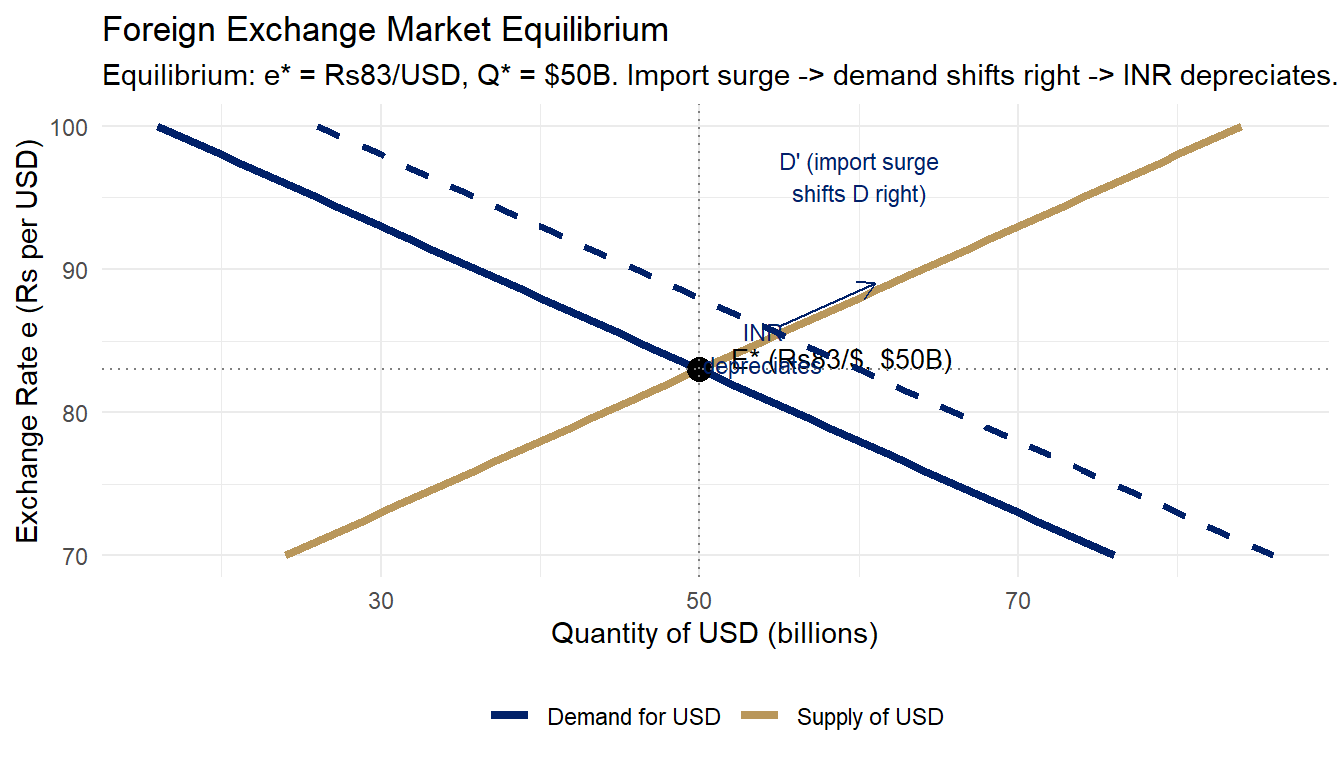
Demand function: As \(e\) rises (INR depreciates), imports become expensive → quantity of USD demanded falls.
\[Q_D = 216 - 2e\]
where \(e\) is ₹ per USD and \(Q\) is billions of USD. Downward-sloping demand curve.
Agricultural angle: India’s edible oil imports (~$14B/year) are the largest agricultural component of USD demand — palm oil from Indonesia/Malaysia, soybean oil from Argentina/Brazil, sunflower oil from Ukraine. A weaker rupee makes every litre more expensive.
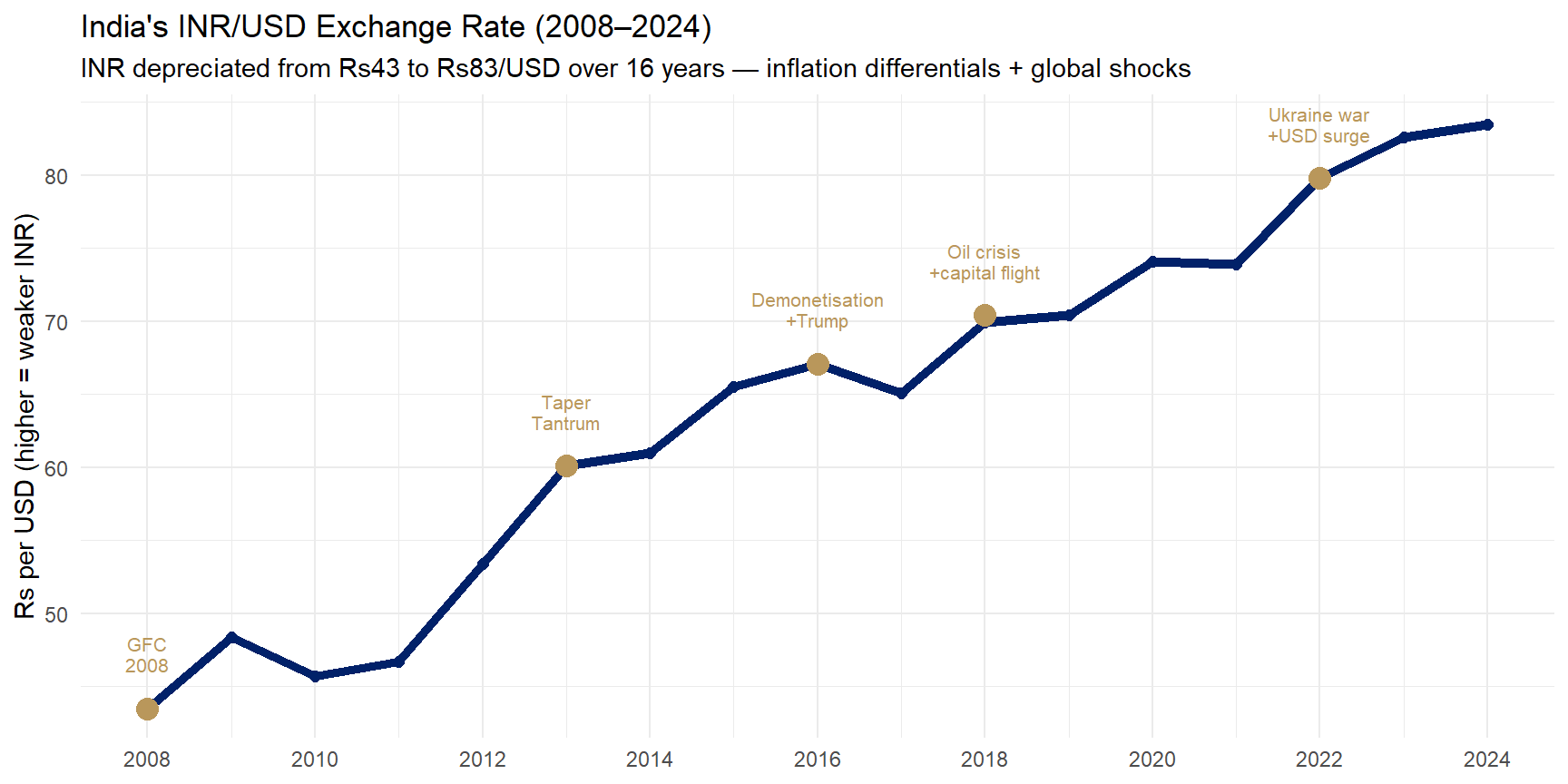
2018: Iran sanctions + crude oil surge. India’s $150B crude import bill inflated → INR hit ₹75.
2022 Ukraine: Sunflower oil import disruption + USD surge → edible oil crisis in India.
Purchasing Power Parity: Absolute PPP
Foundation — Law of One Price: In competitive markets with free trade, identical goods sell at the same price internationally (once converted at the exchange rate).
Absolute PPP: If a representative basket costs ₹4,175 in India and $50 in the USA:
\[e_{PPP} = \frac{P_{India}}{P_{USA}} = \frac{4175}{50} = ₹83.5 \text{ per USD}\]
Absolute PPP says: the exchange rate should equal the ratio of price levels. If the actual rate differs from PPP, there is a real misalignment.
Big Mac Index 2024 — Reality Check:
Item
India
USA
Big Mac price
₹259
$5.69
Implied PPP
₹259/\(5.69 = **₹45.5/\)**
—
Actual rate
₹83.5/$
—
Verdict
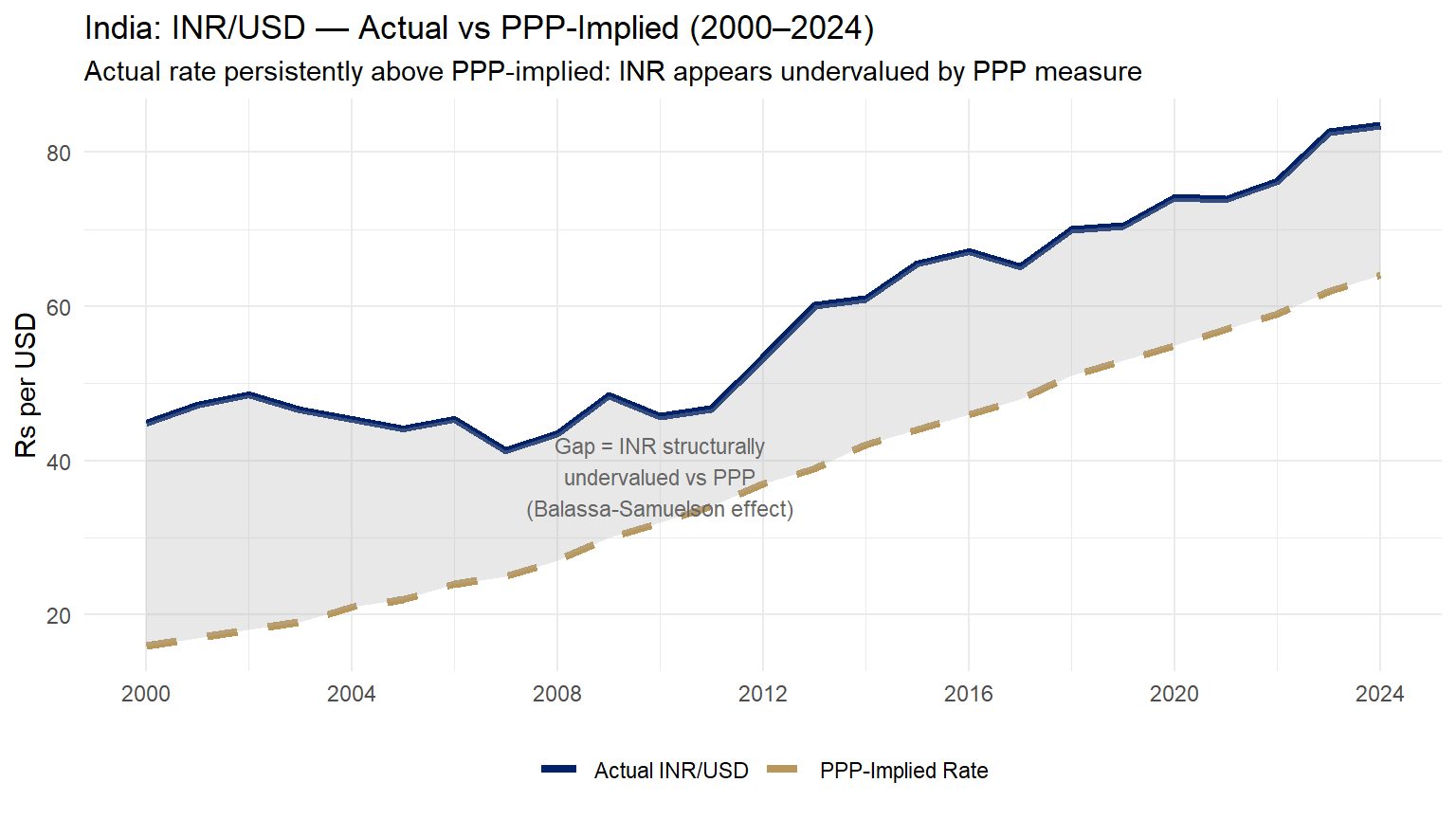
INR undervalued by ~45% vs PPP
—
This does not mean INR is “wrong” — it reflects real structural differences (Balassa-Samuelson effect, see Slide 13).
Relative PPP
Relative PPP: Exchange rates change in proportion to inflation differentials.
\[\% \Delta e \approx \pi_{India} - \pi_{USA}\]
Numerical example:
If India’s inflation \(\pi_{India} = 5\%\) and USA’s \(\pi_{USA} = 2\%\):
\[\% \Delta e = 5\% - 2\% = +3\% \Rightarrow \text{INR depreciates 3\% per year}\]
Long-run empirical test for India:
₹45/USD (2000) → ₹83.5/USD (2024): 85.6% depreciation over 24 years → ~3.5% per year
India avg CPI inflation (2000–2024): ~5.5%; US avg: ~2.2% → differential ≈ 3.3%
✓ Broadly consistent with Relative PPP!
Agricultural implication: Relative PPP predicts that India’s ~3–4% annual INR depreciation roughly offsets the ~3% domestic cost inflation facing Indian farmers. This means Indian agri exports maintain their global price competitiveness in the long run — inflation at home is offset by depreciation in the exchange rate. Short-run deviations, however, create real competitive swings.
Figure 3: India: Actual Exchange Rate vs PPP-Implied Rate (INR/USD, 2000–2024) Source: RBI; World Bank, International Comparison Program (ICP).
Balassa-Samuelson Effect: Fast-growing economies (like India) have high productivity growth in tradables (IT, manufacturing) but not in non-tradables (haircuts, local food). This raises wages overall, making non-tradables expensive. PPP calculations using full CPI baskets therefore understate the “true” exchange rate for a developing economy — the gap between actual and PPP-implied is structurally expected, not a sign of manipulation.
Limitations of PPP
PPP is a powerful long-run benchmark but has important practical limitations:
Non-tradable goods — haircuts, education, land, local restaurants don’t arbitrage across borders. Their prices differ permanently.
Quality differences — a “Big Mac” in Tokyo ≠ a Big Mac in Delhi in quality perception.
Trade barriers — tariffs, quotas, and transport costs prevent price equalisation even for tradables.
Balassa-Samuelson effect — richer/faster-growing countries systematically have currencies above PPP because productivity gains in tradables spill over to raise wages in non-tradables.
Short-run irrelevance — capital flows, sentiment, and central bank intervention dominate short-run exchange rates. PPP explains long-run trends, not day-to-day movements.
Agricultural implication: Agricultural commodities — rice, wheat, cotton, edible oils, spices — ARE tradable goods. PPP-based analysis is therefore more applicable to food prices than to services prices. When the IMF/World Bank assess food affordability across countries, they use PPP-adjusted incomes. India’s apparent INR undervaluation by PPP helps explain why Indian agricultural exports are consistently price-competitive globally.
Interest Rate Parity: Uncovered IRP
Setup: An Indian investor has ₹1 crore to invest for 1 year. Two options:
INR bond earning \(i_{India} = 7\%\) → get ₹1.07 crore in 1 year
USD bond earning \(i_{USA} = 5\%\), but must convert ₹ to $ now and $ back to ₹ later
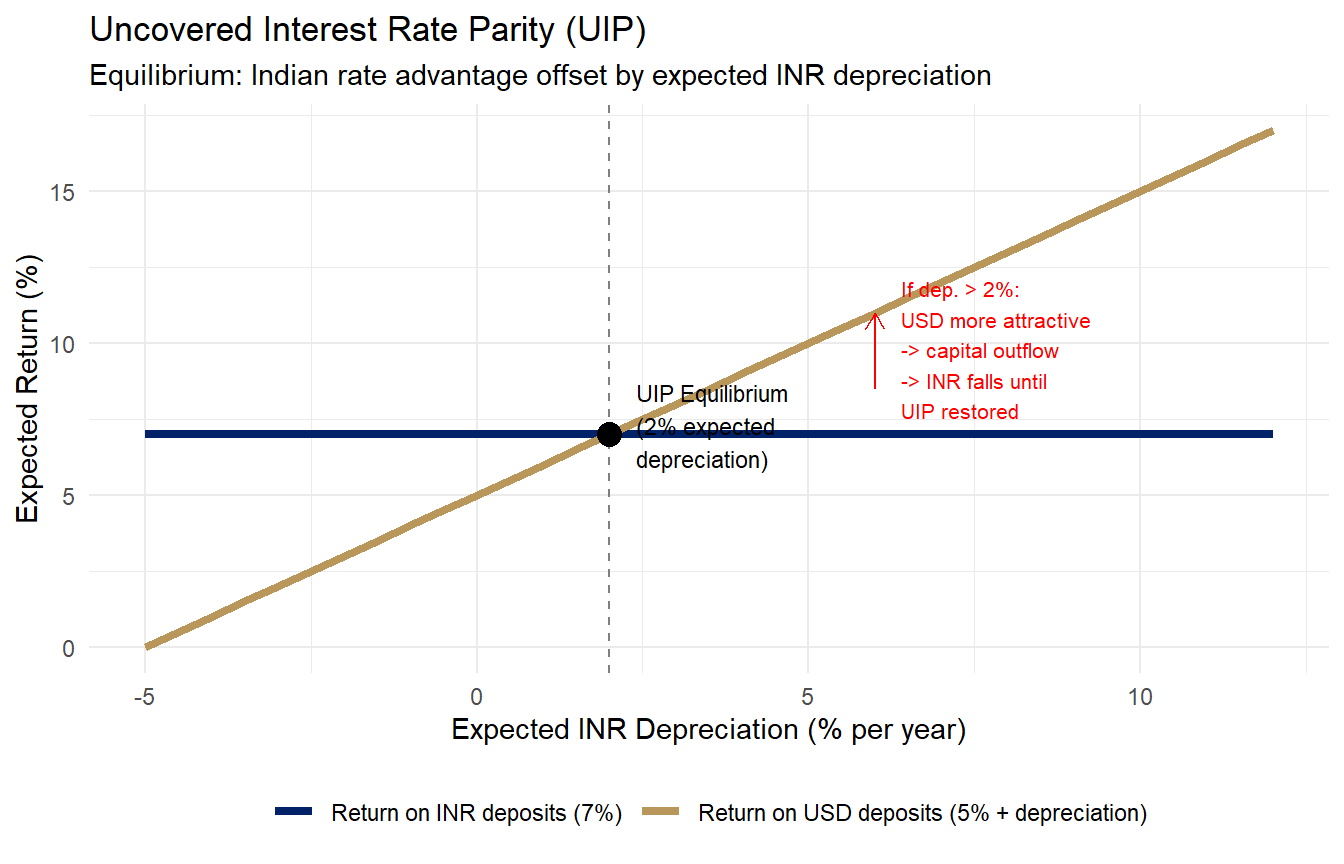
Uncovered Interest Rate Parity (UIP): In equilibrium, expected returns must be equal:
→ Market expects INR to depreciate 2% per year to equalise returns.
Interpretation: India’s higher interest rates do NOT simply attract unlimited capital inflows — because investors price in the expected currency depreciation. The interest rate advantage is exactly offset (in equilibrium) by the expected loss from holding a depreciating currency. This is why India cannot run 8% rates indefinitely without currency pressure.
Interest differential: \(i_{India}=6.5\%\), \(i_{USA}=5.3\%\) → \(\Delta i = 1.2\%\)
Gap (3.35% vs 1.2%) is explained by country risk premium on Indian sovereign debt.
Agri exporter hedging via CIP: A rice exporter expecting \(5M in 6 months sells USD forward at ₹84.2/\). CIP guarantees the forward rate is fairly priced relative to the interest differential — no “free money” from hedging, but the exporter eliminates revenue uncertainty. The forward premium (3.35%) is the cost of certainty.
RBI Intervention in the Forex Market
How RBI intervenes:
Preventing excessive depreciation: RBI sells USD from reserves → increases USD supply in market → reduces e (strengthens INR)
When RBI buys USD (injects ₹ into economy): 1. Buy USD → ₹ liquidity increases (inflationary) 2. Simultaneously sell government securities (G-secs) → absorbs ₹ back 3. Net effect: money supply neutral, but forex reserves increase
India’s forex reserve trajectory:
Year
Reserves
Import cover
1991
$1.2B
2 weeks (crisis)
2004
$113B
~12 months
2014
$304B
~8 months
2024
~$645B
~11 months
Sterilisation and agriculture:
When RBI sterilises USD purchases: - G-sec yields are kept from falling - Domestic interest rates remain higher - This keeps credit costs for agri sector elevated
RBI’s twin mandate — currency stability + price stability — creates a constant tension in agri credit markets.
India is NOT classified as a currency manipulator by the US Treasury — interventions are two-sided and RBI has intervened in both directions over 2022–2024.
Determinants Summary Table
Factor
Channel
Effect on e (₹/$)
INR Direction
India inflation ↑
PPP/competitiveness
e ↑
Depreciates
India growth ↑ → imports ↑
Current account
e ↑
Depreciates
FDI/FPI outflows ↑
Capital account
e ↑
Depreciates
Oil prices ↑ (India imports 85%)
Import demand
e ↑
Depreciates
US Fed raises rates
Carry trade reversal
e ↑
Depreciates
Remittances ↑
Capital inflows
e ↓
Appreciates
RBI raises repo rate
Capital inflows
e ↓
Appreciates
Export boom (rice, IT)
Current account
e ↓
Appreciates
Implications for Agricultural Trade
Depreciation (e ↑: ₹75→₹85) — Winners (Exporters):
🌾 Rice (~$10B/yr): world’s No.1 exporter; ~10.7% cheaper for importers
Market equilibrium:\(Q_D(e) = Q_S(e)\) determines \(e^*\); shifts from trade and capital flows move equilibrium. Solving: \(216-2e = -116+2e \Rightarrow e^* = 83\)
Real exchange rate\(q = e \cdot P^*/P\): only real depreciation — not just nominal — genuinely improves export competitiveness. REER is the trade-weighted measure RBI monitors.
Absolute PPP:\(e_{PPP} = P/P^*\); India’s actual rate >> PPP (Balassa-Samuelson); Relative PPP:\(\Delta e \approx \pi - \pi^*\) — ~3–4% annual INR depreciation predicted and observed over 2000–2024.
Interest Rate Parity (UIP):\(i_{India} - i_{USA} = (E^e - E)/E\); India’s higher rates are offset by expected depreciation — no free lunch from the interest differential.
Agriculture: depreciation boosts rice/cotton/spice exports; raises edible oil/fertiliser import costs — a constant policy tension that explains India’s oscillation between export bans and import duty waivers.
Next Lecture: Exchange Rate Systems and Open Economy Macroeconomics
Lecture 12 (July 11, 2026):
Forex Market — Exchange Rate Systems and Open Economy Macro
We will cover:
Fixed vs floating vs managed exchange rate systems
The Impossible Trinity (Mundell trilemma)
Mundell-Fleming model: IS-LM-BP
Fiscal and monetary policy effectiveness under different regimes
RBI’s managed float in practice
India’s forex reserves: from crisis to abundance
Forward market and currency hedging
Exchange rate pass-through to agricultural prices
Bridge from today:
Today we learned how the rupee rate is determined by supply/demand, PPP, and interest rate parity.
Next lecture we study:
What system India operates under
How government policy affects the exchange rate
How open-economy macroeconomics links monetary policy, fiscal policy, and the exchange rate
Reading: Salvatore Ch 14-15; Appleyard Ch 20-21
Appendix
Additional Resources
Further Reading
International Economics — Salvatore (Ch. 15-16)
International Economics — Appleyard & Field (Ch. 15-16)