Lecture 1: Introduction to International Trade

Econ 2203 | International Trade and Policy in Agriculture

Nithin M

Department of Development Economics

2026-04-25

Course Overview: Econ 2203

What this course is about

  • The economics of trade between nations — with a focus on agricultural commodities
  • Why countries trade, who gains, who loses, and what policy should do about it
  • India’s position in global agricultural trade and key policy instruments

Learning objectives

  • Master classical and modern theories of trade
  • Analyse India’s agricultural trade flows and policy environment
  • Evaluate trade policy tools: tariffs, quotas, subsidies, SPS measures
  • Apply WTO frameworks to real agricultural trade disputes

Assessment: Mid-semester exam (30%) · End-semester exam (40%) · Term paper (20%) · Participation (10%)

Course Roadmap: Lectures 1–9

Lec Topic Date
1 Introduction to International Trade Apr 28
2 Features & Internal vs International Trade May 5
3 Theories I — Mercantilism & Absolute Advantage May 12
4 Theories II — Comparative Advantage May 19
5 Theories III — Factor Endowments (H-O Model) May 26
6 New Trade Theory & Intra-Industry Trade Jun 2
7 Terms of Trade & Trade Gains Jun 9
8 Trade Policy: Tariffs Jun 16
9 Trade Policy: Non-Tariff Barriers Jun 23

Course Roadmap: Lectures 10–18

Lec Topic Date
10 Balance of Payments & Exchange Rates Jun 30
11 WTO Framework & Agreements Jul 7
12 Agreement on Agriculture (AoA) Jul 14
13 SPS & TBT Measures in Agriculture Jul 21
14 India’s Foreign Trade Policy Jul 28
15 Regional Trade Agreements — ASEAN, SAFTA Aug 4
16 Agricultural Price Policy & Trade Aug 11
17 Food Security and Trade Nexus Aug 18
18 Contemporary Issues & Revision Aug 25

What is International Trade?

Definition

International trade is the cross-border exchange of goods, services, and capital between residents of different countries.

Three dimensions of trade

  • Merchandise trade — physical goods: rice, wheat, machinery, petroleum
  • Services trade — IT services, tourism, financial services, education
  • Capital flows — foreign direct investment, portfolio investment, remittances

Why it matters for agricultural economists

  • India earns ~₹3.6 lakh crore from agricultural exports annually
  • Global price signals directly affect domestic farm prices
  • WTO rules constrain domestic agricultural support policies

Core insight: Trade is fundamentally about countries doing what they are relatively better at, and exchanging the surplus — creating gains for all participants.

Why Do Nations Trade?

Supply-side reasons

  • Resource endowments — India has fertile Indo-Gangetic plains; Brazil has Amazon basin → different agricultural outputs
  • Technology differences — Netherlands uses precision horticulture; India relies on labour-intensive methods
  • Specialization gains — Focusing on fewer products reduces unit cost
  • Economies of scale — Large production runs lower average cost (e.g., Thai rice mills)

Demand-side reasons

  • Product variety — Consumers want Darjeeling tea and Colombian coffee
  • Seasonal complementarity — Southern hemisphere harvests when Northern hemisphere is off-season

Scale of Global Trade

Global merchandise trade (2023)

  • Total value: ~$25 trillion (WTO, 2024)
  • Services trade: ~$7 trillion
  • Combined: ~$32 trillion — roughly 30% of world GDP
Rank Country/Bloc Share Year Value (USD trillion)
1 China 14.2% 1950 0.06
2 United States 11.3% 1990 3.5
3 European Union 14.8% 2010 15.3
2023 25.0

Factoid: Global merchandise trade contracted only twice since 1950 — during the 2008–09 financial crisis and the 2020 COVID shock.

India in Global Trade

India’s trade position (FY2024)

Indicator Value
Merchandise exports $437 billion
Merchandise imports $678 billion
Merchandise trade deficit –$241 billion
Services exports ~$340 billion
Services surplus +$160 billion
Total merchandise trade $1.18 trillion

Global rank: 18th in merchandise exports (WTO 2023)

India’s Trade: The Big Picture

Show R code
library(ggplot2)
library(dplyr)

trade_data <- data.frame(
  # FY ending year (FY2015 = Apr 2014–Mar 2015). Source: DGCI&S, MoCI, GoI.
  year    = 2015:2024,
  exports = c(310.3, 262.3, 275.8, 303.5, 330.1, 314.3, 291.8, 422.0, 453.0, 437.1),
  imports = c(448.0, 381.0, 384.4, 465.6, 514.0, 467.2, 394.4, 612.0, 714.2, 677.2)
)
trade_long <- tidyr::pivot_longer(trade_data, cols=c(exports, imports), names_to="type", values_to="value")
trade_long$type <- factor(trade_long$type, levels=c("exports","imports"), 
                           labels=c("Exports","Imports"))

ggplot(trade_long, aes(x=year, y=value, color=type, group=type)) +
  geom_line(linewidth=1.5) +
  geom_point(size=3) +
  geom_ribbon(data=trade_data, aes(x=year, ymin=exports, ymax=imports), 
              inherit.aes=FALSE, fill="grey80", alpha=0.5) +
  scale_color_manual(values=c("Exports"="#012169", "Imports"="#B9975B")) +
  scale_x_continuous(breaks=2015:2024) +
  scale_y_continuous(labels=scales::dollar_format(suffix="B")) +
  labs(title="India's Merchandise Trade Trend (FY2015–FY2024)",
       subtitle="Trade deficit peaked at $261B in FY2023; FY2021 dip reflects COVID. Source: DGCI&S, MoCI, GoI",
       x=NULL, y="USD Billion", color=NULL) +
  theme_minimal(base_size=11) +
  theme(legend.position="bottom", axis.text.x=element_text(angle=45, hjust=1))
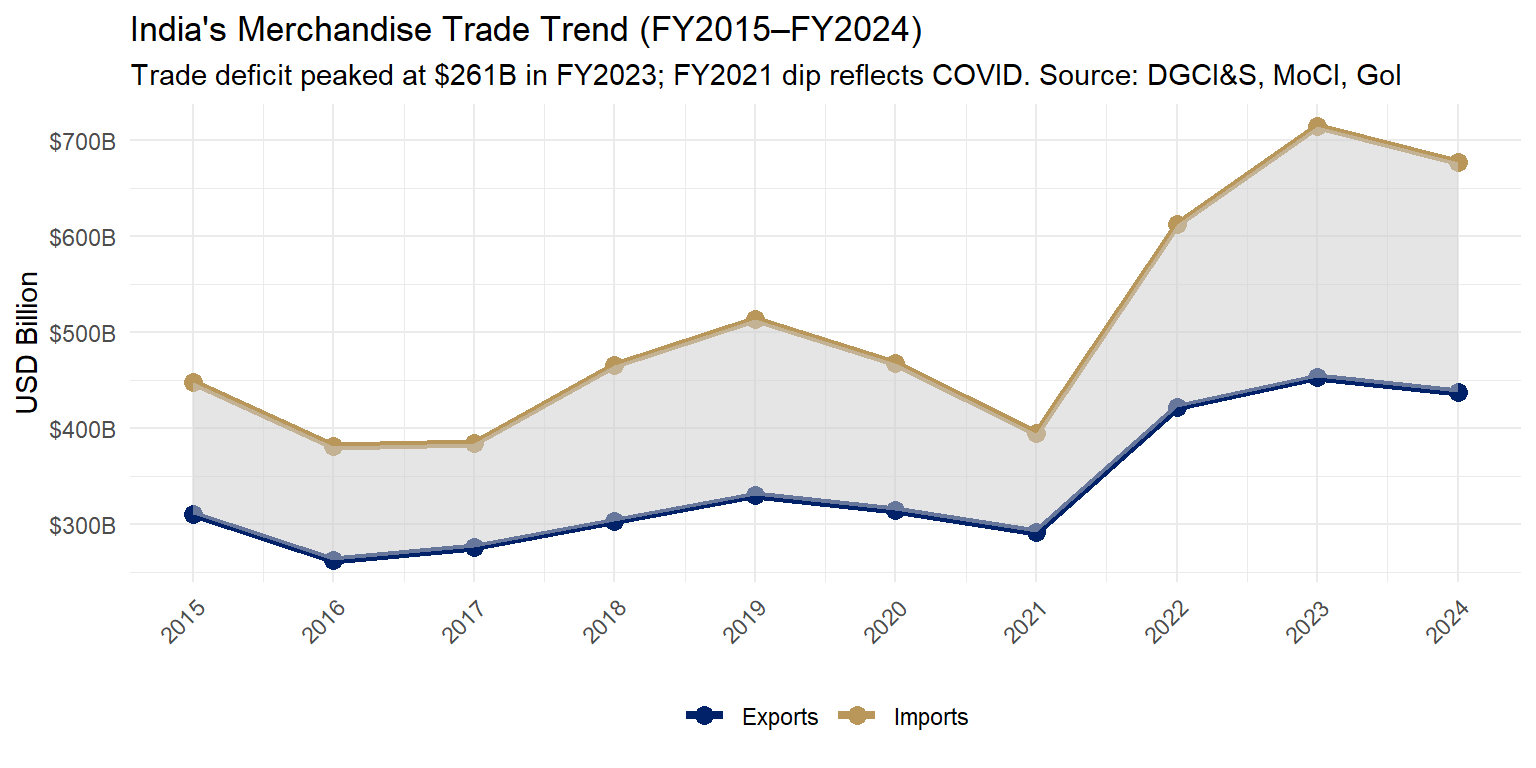
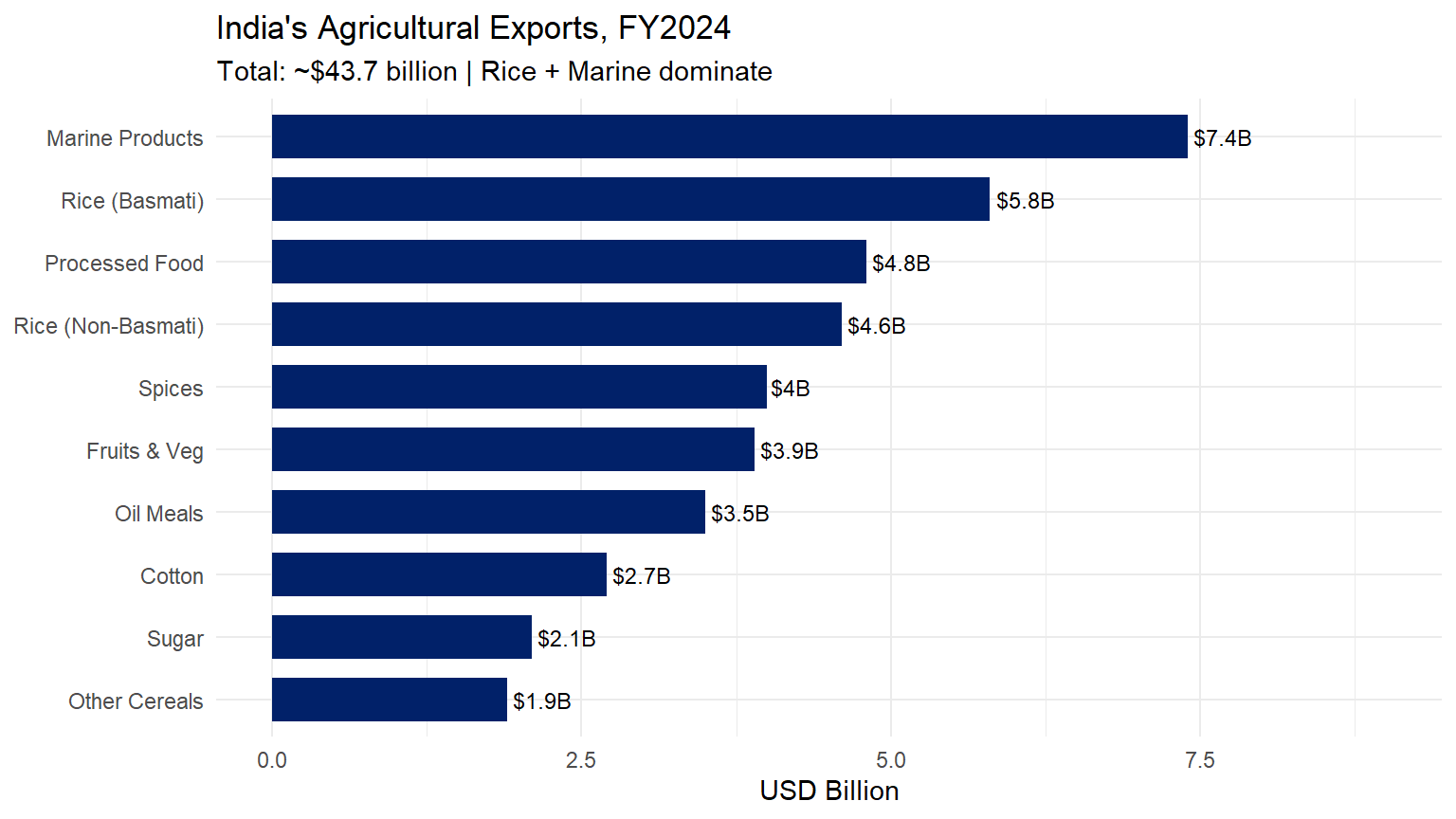
Figure 1: India’s Merchandise Trade (FY2015–FY2024, USD billion) Source: DGCI&S / Ministry of Commerce and Industry (GoI).

India’s Agricultural Trade: FY2024

Top agricultural exports and imports

Commodity (Exports) Value (USD bn) Commodity (Imports) Value (USD bn)
Rice (Basmati + Non-Basmati) 10.4 Edible oils (palm, soy) 14.2
Marine products 7.4 Pulses 3.0
Spices 4.0 Cashew (raw) 1.8
Buffalo meat 3.5 Fresh fruits 1.5
Sugar 2.1 Spices (select) 0.8
Total agri exports ~43.7 Total agri imports ~28.2

Agricultural trade surplus: ~$15.5 billion

Source: APEDA / DGCI&S, 2024

India’s Agricultural Trade Profile

Show R code
library(ggplot2)

agri_data <- data.frame(
  commodity = c("Rice (Basmati)", "Rice (Non-Basmati)", "Marine Products",
                "Spices", "Sugar", "Cotton", "Other Cereals", "Processed Food",
                "Fruits & Veg", "Oil Meals"),
  value = c(5.8, 4.6, 7.4, 4.0, 2.1, 2.7, 1.9, 4.8, 3.9, 3.5)
)
agri_data <- agri_data |> arrange(value) |>
  mutate(commodity=factor(commodity, levels=commodity))

ggplot(agri_data, aes(x=commodity, y=value)) +
  geom_col(fill="#012169", width=0.7) +
  geom_text(aes(label=paste0("$", value, "B")), hjust=-0.1, size=3.2) +
  coord_flip() +
  labs(title="India's Agricultural Exports, FY2024",
       subtitle="Total: ~$43.7 billion | Rice + Marine dominate",
       x=NULL, y="USD Billion") +
  scale_y_continuous(limits=c(0,9)) +
  theme_minimal(base_size=11)

Figure 2: India’s Agricultural Exports by Commodity, FY2024 (USD billion) Source: APEDA Annual Report 2023–24.

Agriculture’s Share in India’s Trade

Export side

  • Agriculture: ~10% of total merchandise exports ($43.7B of $437B)
  • Engineering goods: ~26% | Petroleum products: ~17% | Gems & jewellery: ~10%
  • Agriculture is India’s second-largest net foreign exchange earner after services
  • India’s strengths: rice, spices, marine products, cotton — all labour-intensive, climate-favoured commodities

Import side

  • Edible oils: India imports 60–65% of its edible oil requirement (palm, soybean, sunflower)
  • Pulses: Canada, Australia, Myanmar — ~25% of domestic requirement imported

Vulnerability: India’s dependence on imported edible oils (~$14B/yr) exposes food inflation to global price shocks, as seen in 2021–22 when palm oil prices spiked 50%.

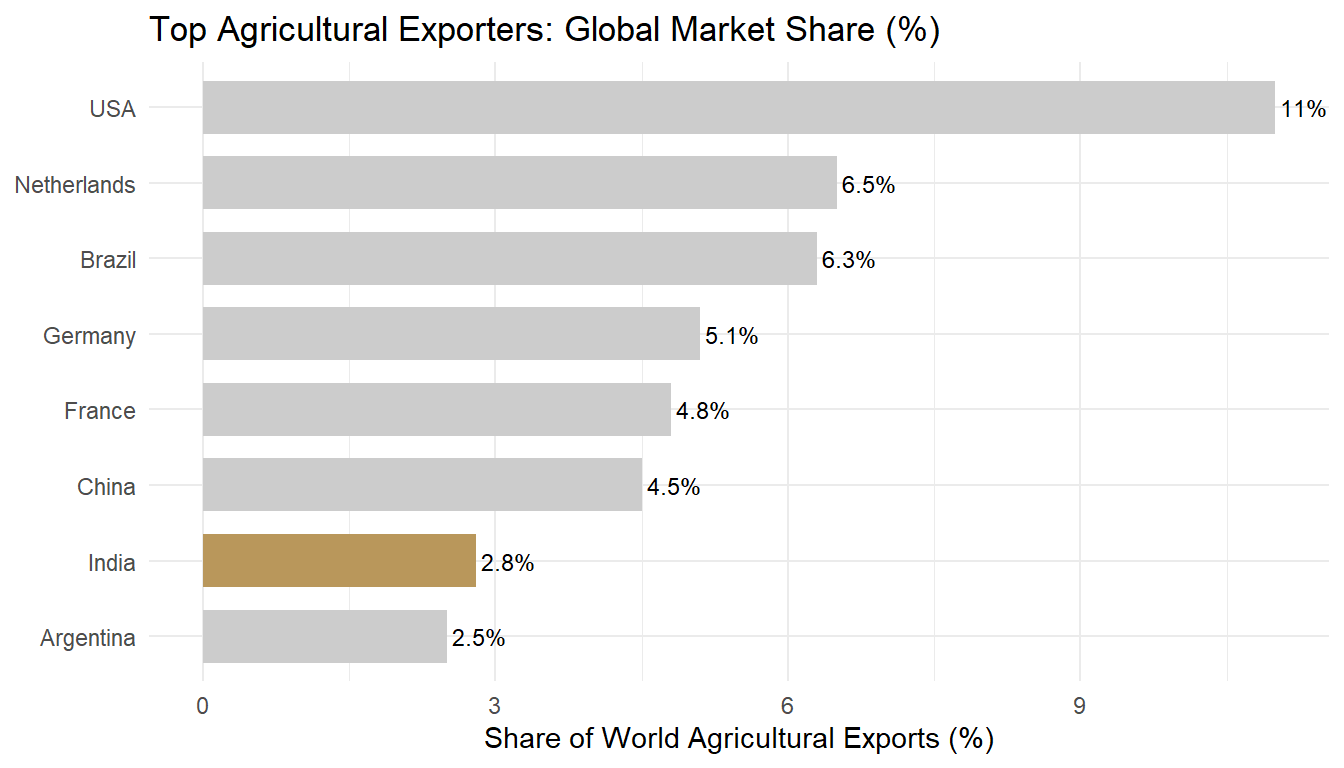
India’s Position in Global Agricultural Trade

Show R code
library(ggplot2)

global_share <- data.frame(
  country = c("USA", "Netherlands", "Brazil", "Germany", "France", "China", "India", "Argentina"),
  share = c(11.0, 6.5, 6.3, 5.1, 4.8, 4.5, 2.8, 2.5)
)
global_share <- global_share |> arrange(share) |>
  mutate(country=factor(country, levels=country),
         highlight=ifelse(country=="India", "India", "Others"))

ggplot(global_share, aes(x=country, y=share, fill=highlight)) +
  geom_col(width=0.7) +
  scale_fill_manual(values=c("India"="#B9975B", "Others"="#cccccc")) +
  coord_flip() +
  labs(title="Top Agricultural Exporters: Global Market Share (%)",
       x=NULL, y="Share of World Agricultural Exports (%)", fill=NULL) +
  theme_minimal(base_size=11) +
  theme(legend.position="none") +
  geom_text(aes(label=paste0(share, "%")), hjust=-0.1, size=3.2)

Figure 3: Major Agricultural Exporters: Global Market Share (2023) Source: WTO, World Agricultural Trade Statistics 2024.

Key Concepts: Theory

Classical trade theory

  • Comparative advantage — trade based on relative, not absolute, efficiency (Ricardo)
  • Factor endowments — land, labour, capital abundance shapes what countries export (Heckscher-Ohlin)
  • Terms of trade — ratio of export prices to import prices; determines gains from trade
  • Intra-industry trade — two-way trade in similar products (India exports basmati, imports parboiled rice)

Key Concepts: Policy

Trade policy instruments

  • Tariff — tax on imports; raises domestic price above world price
  • Non-Tariff Barrier (NTB) — quotas, SPS standards, licensing
  • Balance of Payments (BoP) — accounting of all international transactions
  • Exchange rate — price of one currency in terms of another; stronger rupee makes exports costlier

Why Study International Trade?

Policy relevance for India

  • Foreign Trade Policy 2023–28 targets $2 trillion in merchandise + services exports by 2030
  • WTO commitments constrain India’s ability to protect domestic agriculture (AMS limits; tariff bindings)
  • Farmer income — ~50% of India’s workforce in agriculture; export markets expand income
  • Food security — import policy on pulses and oilseeds directly affects 1.4 billion people

What Makes Agricultural Trade Special?

Biological & physical features

  • Perishability — fresh produce, milk, meat have short shelf-lives → need cold chains, quick clearance
  • Seasonality — harvests are discrete events; supply is lumpy
  • Bulkiness — grain, sugar, cotton: high weight-to-value ratio → high freight costs
  • Sanitary risks — food-borne pathogens cross borders with commodities → SPS measures justified

Economic & political features

  • Food security concern — governments intervene to ensure domestic supply; export bans, import duty waivers are common
  • WTO special treatment — Agreement on Agriculture has Special and Differential Treatment for developing countries

India’s Export Destinations (FY2024)

Top merchandise export destinations

Rank Country Share of exports Key agri exports
1 United States ~18% Marine, spices
2 UAE ~6.5% Rice, meat, fruits
3 Netherlands ~4.2% Spices, cotton
4 China ~3.8% Cotton, castor oil
5 Bangladesh ~3.5% Rice, onion, sugar

India’s Import Sources (FY2024)

Top merchandise import sources

Rank Country Share of imports Key agri imports
1 China ~15% Electronics, chemicals
2 UAE ~7.5% Crude oil, gold
3 USA ~6.2% Pulses, capital goods
4 Russia ~5.8% Crude oil, fertilisers
5 Saudi Arabia ~5.4% Crude oil, edible oils

Composition of India’s Merchandise Exports

Major export categories (FY2024, approx.)

Category Value (USD bn) Share
Engineering goods 112 25.6%
Petroleum products 78 17.8%
Gems & jewellery 44 10.1%
Chemicals 36 8.2%
Agriculture & allied 44 10.1%
Textiles & apparel 35 8.0%
Electronic goods 29 6.6%
  • Engineering goods grew from 12% (2000) to 26% (2024)
  • Agriculture has held a stable ~10–12% share for two decades

Foreign Trade Policy 2023-28: Five Pillars

Foreign Trade Policy (FTP) 2023–28: Key pillars

  1. Export target: $2 trillion merchandise + services exports by 2030
  2. Districts as Export Hubs (DEH): Identify 1 product per district with export potential; provide targeted support
  3. ECGC coverage: Expanded Export Credit Guarantee Corporation cover to de-risk exporters, especially MSMEs
  4. Remission of Duties and Taxes on Exported Products (RoDTEP): Replace old MEIS; neutralise embedded taxes
  5. E-commerce exports: Dedicated policy for cross-border e-commerce; target $200–300B by 2030

FTP 2023-28: Agriculture-Specific Provisions

Agricultural trade–specific provisions

  • Agri-specific chapters supporting APEDA-registered exporters
  • GI tag promotion (Darjeeling tea, Alphonso mangoes, Basmati rice)
  • Simplification of phytosanitary certification processes

FTP 2023–28 is notably continuity-oriented — it builds on previous policy architecture rather than a radical overhaul, reflecting India’s cautious approach to trade liberalisation.

A Preview: The Basic Trade Model (I)

PPF — conceptual preview

Without trade (autarky)

  • A country produces and consumes on its PPF
  • The slope of the PPF = the domestic relative price
  • Example: India producing only rice and wheat — the trade-off is fixed by domestic technology

A Preview: The Basic Trade Model (II)

With trade (open economy)

  • World price ratio differs from domestic price ratio
  • Country specialises in the good where it has comparative advantage
  • Consumption point can now lie outside the PPF — both countries gain

Key Definitions (I)

Trade flows

  • Exports — goods/services sold to foreign residents; flow of goods out, money in
  • Imports — goods/services bought from foreign residents; flow of goods in, money out
  • Trade balance = Exports − Imports (positive → surplus; negative → deficit)
  • Visible trade — physical merchandise (rice, cars, oil)
  • Invisible trade — services, remittances, investment income

Key Definitions (II)

Balance of Payments

  • Current account — trade in goods + services + remittances + investment income
  • Capital account — financial flows: FDI, portfolio investment, loans
  • BoP identity: Current account + Capital account = 0 (approximately)

Exchange rate

  • Nominal exchange rate — ₹/USD; e.g., ₹83 = $1
  • Real exchange rate — adjusts for price level differences; determines actual competitiveness

Summary: Why International Trade Matters

Four reasons international trade is essential for India

  1. Growth engine: Trade has been central to every development success story — Japan, South Korea, China, and now India’s IT sector

  2. Consumer welfare: Trade gives 1.4 billion Indians access to goods they cannot produce cheaply at home

  3. Farmer incomes: Export markets for rice, spices, and marine products support millions of rural households

  4. Policy discipline: WTO commitments create external pressure for domestic policy reform

Key Takeaways: Lecture 1

What we covered today

  • International trade = cross-border exchange of goods, services, and capital
  • Global merchandise trade: ~$25 trillion (2023); services: ~$7 trillion
  • India ranks 18th in merchandise exports; total trade ~$1.18 trillion (FY2024)
  • Agricultural exports: $43.7 billion (FY2024) — rice, marine, spices, cotton dominate
  • India has a structural agricultural trade surplus (~$15.5B) that helps offset the merchandise deficit

Questions to think about before next lecture:

  1. Why does India ban rice exports during domestic inflation? Who benefits, who loses?
  2. If India has absolute advantage in producing rice, why does Bangladesh also export rice?

Next Lecture: Lecture 2

Features of International Trade (May 5, 2026)

We will cover:

  • Salient features of international trade that distinguish it from domestic trade
  • Immobility of factors — why labour and capital don’t flow freely across borders
  • Currency and exchange risk — how rupee movements affect export competitiveness
  • Internal vs international trade — a systematic comparison
  • The gravity model — intuition and India examples

Appendix

Additional Resources

Further Reading

  • International Economics — Salvatore (Ch. 1)
  • International Economics — Appleyard & Field (Ch. 1)
  • RBI/DGCI&S/APEDA databases for latest data

Key Data Sources

  • DGCI&S: India’s merchandise trade
  • RBI: Balance of payments data
  • APEDA: Agricultural export statistics
  • WTO: Tariff and trade databases